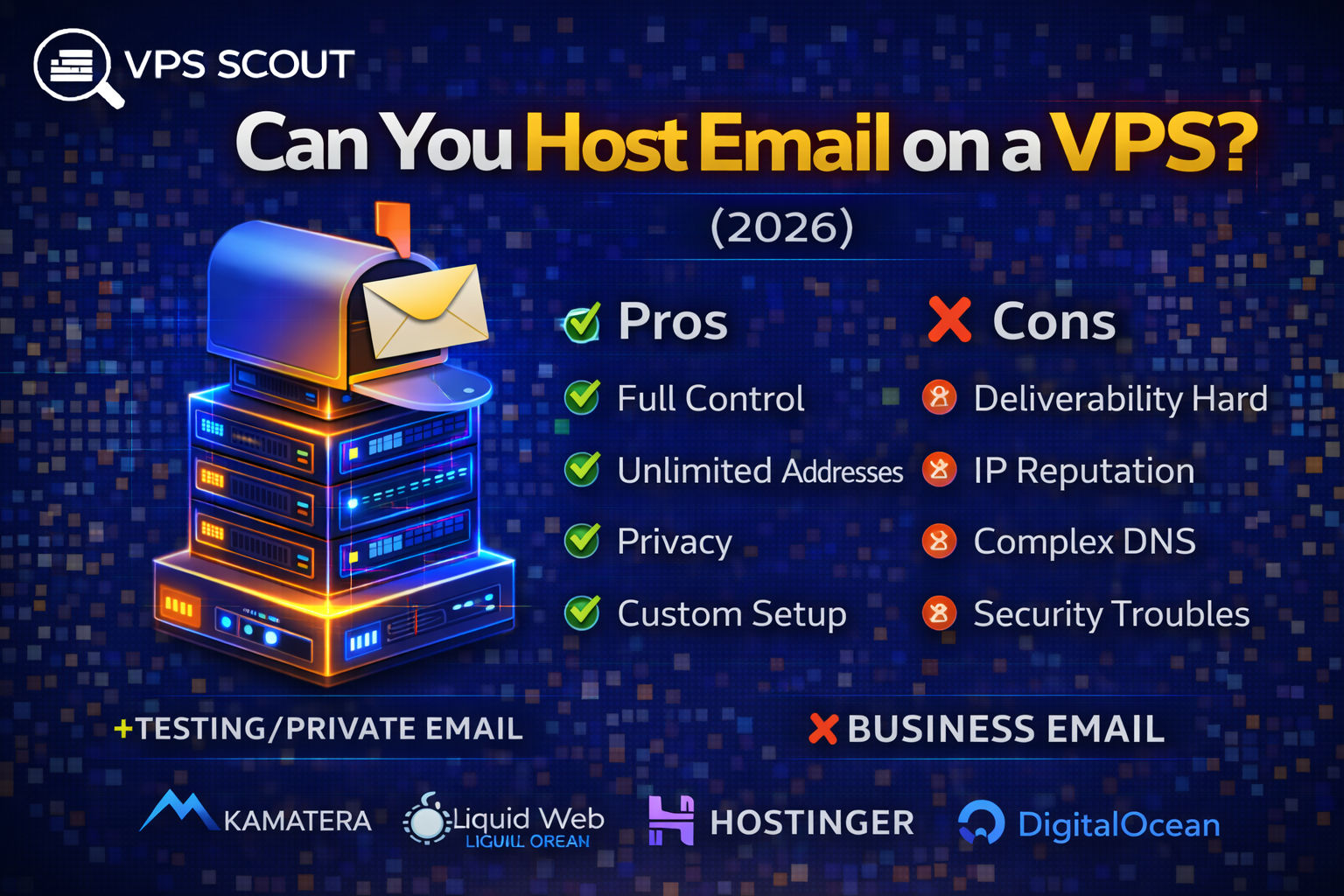
Hosting email on a VPS provides full administrative control, enhanced privacy, and the ability to create unlimited mailboxes. This approach allows technical users to manage their own software stacks and security policies. It is particularly suitable for internal communication, testing environments, and specialized configurations that avoid vendor lock-in.
Self-hosting requires managing complex DNS records and maintaining IP reputation to ensure deliverability. Challenges include blocked ports, frequent security threats, and the risk of messages being flagged as spam. Most businesses should consider professional email providers to ensure reliable communication and reduce the technical burden of server maintenance.
Yes — you can host email on a VPS.
But the better question is:
Should you?
Because self-hosted email is one of those things that sounds simple… until you deal with:
- emails going to spam
- blacklisted IPs
- DNS mistakes
- spam bots hammering your server
- constant deliverability troubleshooting
This guide explains the real pros and cons of hosting email on a VPS in 2026, and when it makes sense.
Quick Answer
✅ Yes, you can host email on a VPS.
⚠️ But for most businesses, it’s not worth the deliverability risk.
Self-hosted VPS email is best for:
- technical users
- privacy-focused setups
- internal company email
- testing environments
What Does “Hosting Email on a VPS” Mean?
Hosting email on a VPS means your server handles:
- sending mail (SMTP)
- receiving mail (IMAP/POP3)
- storing mailboxes
- spam filtering
- antivirus scanning
- TLS certificates
- DNS records (SPF, DKIM, DMARC)
Common software stacks include:
- Postfix + Dovecot
- Mailcow (Docker-based)
- iRedMail
- Mail-in-a-Box
Pros of Hosting Email on a VPS
Let’s start with the good stuff.
✅ 1) Full Control
You control:
- domains
- mailboxes
- storage
- spam filtering rules
- security policies
No vendor lock-in.
✅ 2) Unlimited Email Addresses (Usually)
With hosted email providers, you often pay per mailbox.
With a VPS, you can create:
- unlimited addresses
- unlimited aliases
- catch-all mailboxes
✅ 3) Privacy
Your email data stays on your server.
This matters for:
- privacy-conscious users
- sensitive organizations
- compliance-focused teams
✅ 4) Custom Setup Options
You can build advanced setups like:
- multiple domains
- internal-only mail
- custom spam filtering
- relay servers
✅ 5) Can Be Cheaper (Sometimes)
If you host mail for multiple domains and many mailboxes, a VPS can be cheaper than paying per user.
But this only applies if:
- you manage it yourself
- you don’t value your time too cheaply
Cons of Hosting Email on a VPS (The Real Problems)
This is where most people get surprised.
❌ 1) Deliverability Is Hard
This is the biggest issue.
Even if your server is perfectly configured, your emails can still land in spam because:
- your IP has a bad reputation
- your VPS provider’s network is flagged
- your domain is new
- your sending patterns look suspicious
❌ 2) IP Reputation Can Destroy Your Setup
Many VPS providers reuse IPs.
If the previous owner used the IP for spam, you inherit the damage.
This can cause:
- spam folder delivery
- outright rejections
- blacklists
❌ 3) Many VPS Providers Block Port 25
Port 25 is needed for sending mail directly.
Many cloud VPS providers block outbound SMTP to prevent spam abuse.
This means you may need:
- support approval
- an SMTP relay service
- a different provider
❌ 4) DNS Setup Is Easy to Mess Up
To run email properly, you need:
- SPF
- DKIM
- DMARC
- PTR (reverse DNS)
- proper hostname (FQDN)
One missing record = spam problems.
❌ 5) Email Servers Are Constantly Attacked
Mail servers get hammered with:
- brute force login attempts
- spam relaying attempts
- bot scanning
- exploit attempts
You must secure the VPS properly.
Read next: How to secure a VPS
❌ 6) You Become the Support Team
When email breaks, it’s not like a website.
It can break in subtle ways:
- some emails deliver, others don’t
- Gmail works but Outlook fails
- attachments fail
- messages delay for hours
And you’re the one troubleshooting.
❌ 7) Backups Are More Important Than You Think
If you lose your mailboxes, you lose:
- invoices
- customer communication
- contracts
- password reset emails
A VPS email server without backups is a disaster waiting to happen.
When Hosting Email on a VPS Makes Sense
Self-hosted VPS email is a good idea if:
✅ you’re technical
✅ you understand DNS
✅ you can manage Linux updates
✅ you can secure SSH properly
✅ you can monitor logs
✅ you accept deliverability issues as “part of the game”
When You Should NOT Host Email on a VPS
You should avoid self-hosting email if:
❌ you run a business that depends on email
❌ you can’t afford spam-folder delivery
❌ you don’t want to manage security
❌ you need guaranteed deliverability
❌ you want “set and forget”
In that case, use:
- Google Workspace
- Microsoft 365
- Zoho Mail
- Proton Mail
The Best “Hybrid” Approach (Recommended)
This is the smartest setup for most people:
✅ Host websites/apps on your VPS
✅ Use a professional email provider for mail
This gives you:
- speed + control for your sites
- reliable deliverability for email
- less stress
If You Still Want to Do It: VPS Email Hosting Checklist
If you’re going to self-host email, do this:
VPS Requirements
✅ clean IP reputation
✅ reverse DNS support
✅ port 25 open (or relay plan)
✅ stable uptime
✅ provider that allows mail hosting
Read next: Best VPS for Email Hosting
DNS Requirements
✅ SPF
✅ DKIM
✅ DMARC
✅ PTR record
✅ correct hostname
Security Requirements
✅ firewall rules
✅ Fail2ban
✅ strong passwords
✅ 2FA where possible
✅ automatic security updates
Read next: Do you need a firewall on a VPS?
FAQ: Hosting Email on a VPS
Can I host email on a $5 VPS?
Technically yes, but deliverability and IP reputation are the real problems — not CPU/RAM.
Is hosting email on a VPS secure?
It can be secure if hardened properly, but mail servers are a high-value target.
Why does my VPS email go to spam?
Most common reasons:
- bad IP reputation
- missing SPF/DKIM/DMARC
- no reverse DNS
- sending too many emails too quickly
What is the best VPS for email hosting?
Providers with:
- better IP pools
- stable infrastructure
- rDNS support
Read next: Best VPS for Email Hosting
Final Verdict: Can You Host Email on a VPS?
✅ Yes — you can.
⚠️ But it’s not “easy hosting,” it’s “email infrastructure.”
If you’re technical and want full control, it can be a great project.
If you need business reliability, use a professional hosted email provider.