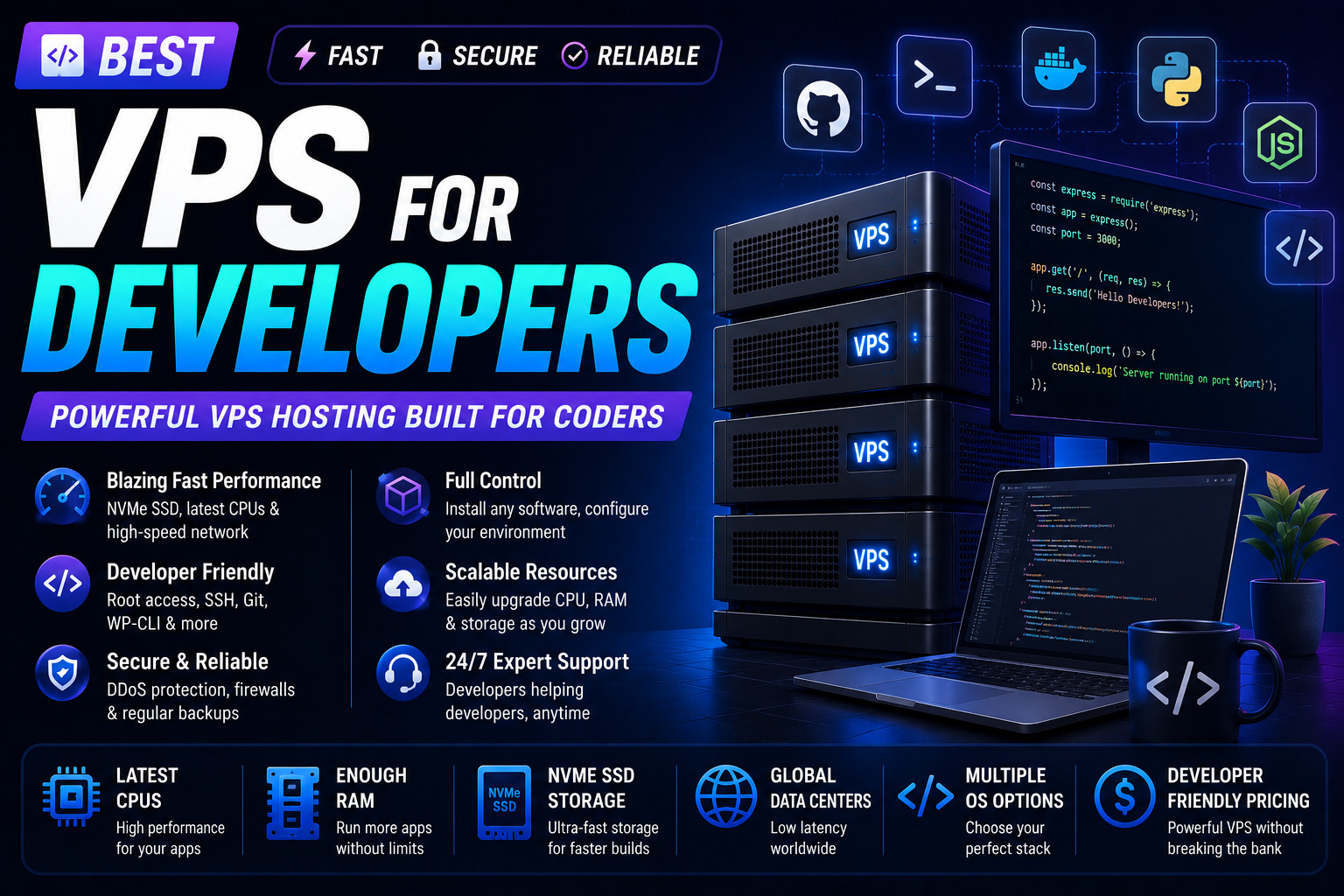
If you’re a developer, choosing a VPS is different from choosing hosting for a blog.
You don’t just need “fast.”
You need a VPS that supports real developer workflows like:
- Docker + Docker Compose
- Git deployments
- CI/CD pipelines
- staging environments
- API hosting
- databases (PostgreSQL, Redis, MySQL)
- monitoring + logging
- predictable performance
And you need it without:
- surprise throttling
- weird restrictions
- unstable CPU nodes
- bad network routing
This guide covers the best VPS hosting providers for developers in 2026, what makes a VPS developer-friendly, and which provider is best for each use case.
Quick Picks: Best VPS for Developers (2026)
If you want the fastest answer:
- Best overall VPS for developers: Vultr
- Best for scaling and custom setups: Kamatera
- Best for Git + simple deployments: Linode
- Best for advanced cloud workflows: AWS Lightsail (beginner cloud)
What Developers Should Look for in a VPS (2026)
Here’s what matters most for developer VPS hosting:
1) Consistent CPU Performance
Many “cheap VPS” providers oversell CPU.
That’s a nightmare for:
- builds
- Docker containers
- CI pipelines
- compiling dependencies
Read next: VPS CPU requirements
2) NVMe Storage
NVMe makes a huge difference for:
- databases
- Docker image pulls
- build caching
- dependency installs
Read next: SSD vs NVMe VPS
3) Clean Networking + Low Latency
For developers, network matters for:
- Git cloning
- pulling packages
- API response time
- global users
Read next: How to choose VPS location
4) Snapshot + Backup Support
Snapshots are critical for dev workflows:
- rollback instantly
- clone environments
- test upgrades safely
5) A Good API / Dashboard
Developers love providers with:
- fast provisioning
- clean UI
- automation options
Best VPS Hosting Providers for Developers (2026)
1) Vultr — Best Performance Per Dollar (Developer Favorite)
Vultr is a top pick for developers who want:
- raw performance
- global locations
- NVMe speed
Vultr often gives better performance per dollar than DigitalOcean.
Pros
- Excellent NVMe performance
- Great global coverage
- Very strong network routing
Cons
- UI is more “infrastructure” than beginner
- Support is not as hand-holding
➡️ Best for: Docker, APIs, SaaS, staging/prod environments.
➡️ Best for: fast deployments, performance-focused apps.
Read next: Fastest VPS hosting providers
➡️ Best for: EU apps, agencies, dev teams.
Read next: Best VPS hosting in Europe
2) Kamatera — Best VPS for Scaling (Developer Flexibility)
Kamatera is great when you want:
- flexible server configs
- scaling up/down
- many locations
It’s often used by:
- SaaS companies
- growing apps
- scaling ecommerce
Pros
- Highly scalable
- Many global datacenters
- Strong network
Cons
- UI is more complex
- Managed support is an add-on
➡️ Best for: scaling workloads, SaaS, growth projects.
Read next: VPS vs cloud hosting
3) Linode — Best Balanced VPS for Developers
Linode is known for:
- stability
- fair pricing
- solid infrastructure
- good US performance
It’s a great choice for developers who want:
- predictable hosting
- clean setups
- fewer surprises
Pros
- Reliable performance
- Good pricing
- Strong US datacenters
Cons
- Not as many global locations
- Less “modern ecosystem” than DO
➡️ Best for: stable production VPS hosting.
4) AWS Lightsail — Best “Beginner Cloud VPS”
AWS Lightsail is a good choice if you want:
- a VPS-like experience
- inside AWS ecosystem
It’s useful if you plan to grow into:
- EC2
- RDS
- S3
- CloudFront
Pros
- Great network
- Easy entry into AWS
- Useful for cloud workflows
Cons
- More complex than normal VPS
- Pricing can become confusing
➡️ Best for: developers who want AWS exposure.
Best VPS for Developers by Use Case
Best VPS for Docker + Docker Compose
Top picks:
Best VPS for Git + simple deployments
Top picks:
- Linode
Best VPS for CI/CD pipelines
Top picks:
- Vultr
- Kamatera
Best VPS for PostgreSQL / Redis / databases
Top picks:
Best VPS for staging + production environments
Top picks:
Recommended VPS Specs for Developers (2026)
Here are realistic specs depending on your workflow:
Beginner dev VPS (learning + testing)
- 1–2 vCPU
- 2GB RAM
- 40GB SSD/NVMe
Real Docker projects
- 2 vCPU
- 4GB RAM
- 60GB NVMe
CI/CD + databases + multiple containers
- 4 vCPU
- 8GB RAM
- 100GB NVMe
Read next: VPS RAM requirements
Developer VPS Checklist (Before Buying)
Make sure the provider supports:
✅ Ubuntu / Debian images
✅ SSH keys
✅ Snapshots
✅ Fast NVMe storage
✅ Datacenter near your users
✅ Optional private networking
✅ Good bandwidth
✅ Clear pricing
FAQ: Best VPS for Developers
What is the best VPS for developers?
For most developers, DigitalOcean is the best overall VPS provider in 2026 due to consistent performance, great documentation, and clean developer workflows.
Is VPS good for Docker?
Yes. VPS hosting is one of the best ways to run Docker because it gives you full control and predictable performance.
Is a $5 VPS enough for development?
For learning and testing, yes. For real apps, CI/CD, and databases, you’ll want at least 4GB RAM.
Read next: Can you trust a $5 VPS?
Should developers use managed VPS?
Most developers don’t need managed VPS unless they want to focus purely on code and avoid server management.
Read next: Best managed VPS hosting
Final Verdict: Best VPS for Developers (2026)
If you want the simplest recommendation:
- Best overall: Vultr
- Best for scaling: Kamatera
- Best stable option: Linode
- Best entry cloud VPS: AWS Lightsail
Next Step
If you want the full provider list (not only for developers):